Raising the Standard: From International Innovation to the Road to ISO Certification
How ELS brought international motorsport safety practice to Australian trackside care, and why it is working towards ISO certification.
By ELS Team
The Evolution of Trackside Emergency Medicine
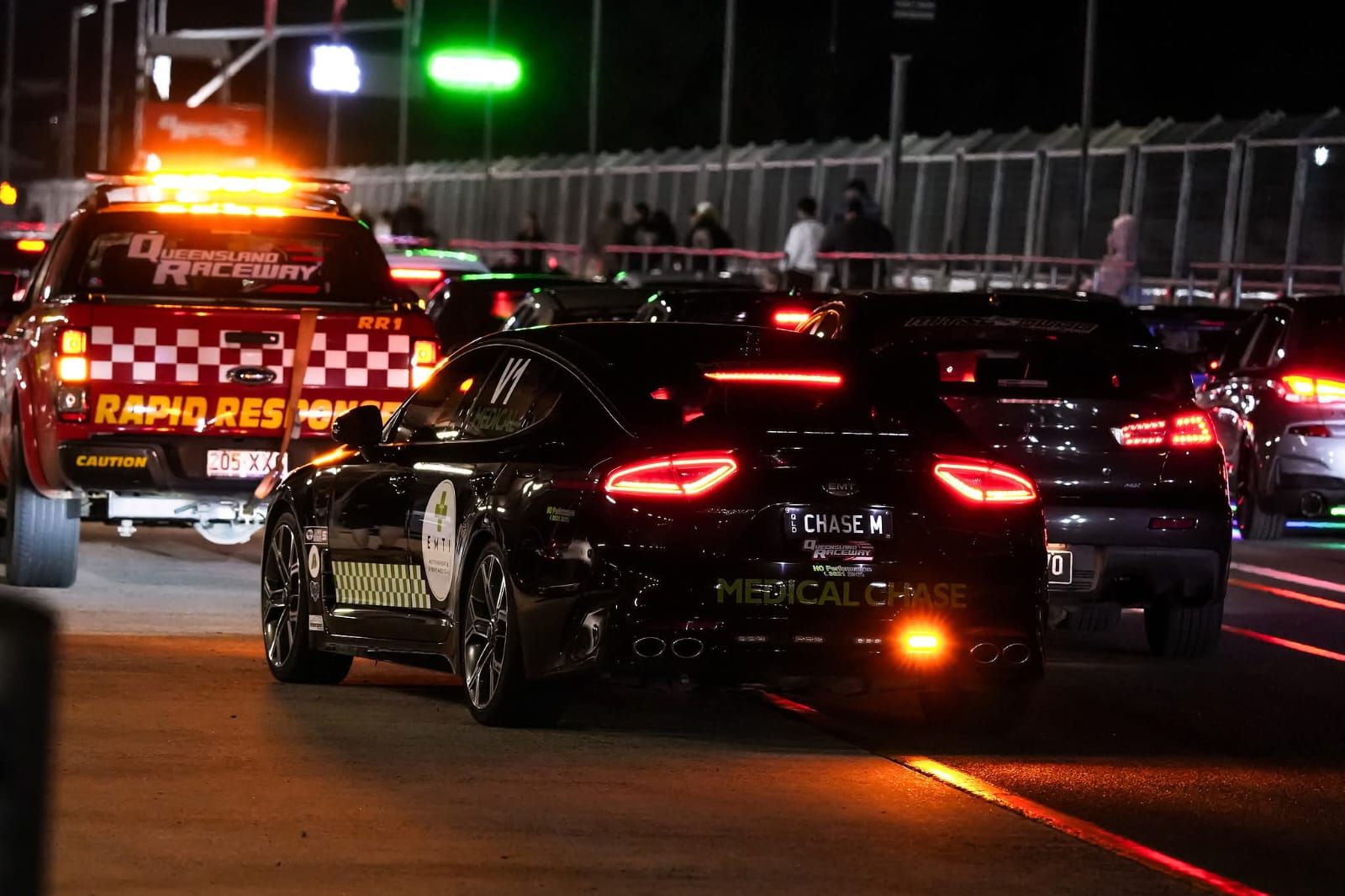
In the early days of Australian motorsport medical response, trackside care was largely rudimentary. Personnel were skilled and dedicated, but operational practices were informal: clinicians often wore basic high-visibility vests and responded in ordinary sedans, working within metres of high-speed race cars without personal impact or fire protection.
Today, motorsport medical intervention in Australia is recognised as a specialised, highly professional discipline. Emergency Logistic Solutions (ELS) was among the providers that helped drive that transformation, with leadership that challenged legacy practices, imported global innovations, and subjected its operations to international quality standards.
Challenging the Status Quo: Bringing Global Innovation to Australia
More than two decades ago, ELS leadership recognised that trackside emergency medical providers faced the same kinetic and thermal hazards as the drivers they were deployed to save. Operating at high speeds on live circuits required major upgrades to personal protective equipment (PPE) and vehicle safety.
ELS looked beyond domestic borders, attending international safety symposiums in Orlando, Florida, to study the systems developed by Formula 1 medical delegations and leading international motorsport bodies. There, ELS engaged directly with the pioneers of life-saving technologies—including the inventors of the Head and Neck Support (HANS) device—and evaluated the gear used by global rapid-intervention teams.
Returning to Australia, ELS became one of the first private medical teams in the country to mandate that its drivers, paramedics, and trackside clinicians wear:
Certified fire-retardant multi-layer race suits.
Balaclavas and fire-resistant gloves.
Approved full-face or open-face motorsport helmets inside fast-response chase vehicles.
While the initiative initially drew scepticism from traditionalists, the logic proved undeniable. Today, fire-retardant suits and helmets are common at top-level motorsport events. By testing and proving these concepts on home circuits, ELS helped establish a new safety benchmark for the entire industry.
Crew Resource Management: Protecting the Medic to Protect the Patient
The philosophy driving ELS’s approach is straightforward: you cannot deliver life-saving clinical care if your responders are injured or incapacitated en route. Whether a chase car hits 170 km/h on a racetrack or navigates rough, unsealed haul roads at an open-cut mine, high-speed travel creates significant physical and cognitive strain. Rapid emergency driving must be smooth, controlled, and paired with active crew resource management.
Response Vehicle Role | Core Operational Responsibilities | Safety Outcome |
|---|---|---|
Specialist Response Driver | Vehicle dynamics, closing speeds, line selection, avoiding track debris, and blind corner positioning. | Reduces the risk of secondary vehicle collisions; arrives safely without disorienting medical staff. |
Passenger Clinician (Paramedic / Nurse) | Navigation, forward scanning for flag changes, radio comms with Race Control, and staging clinical consumables. | Clinician arrives on scene calm, prepared, and ready to conduct immediate advanced life support. |
Institutionalising Quality: The Path to ISO Certification
As industrial clients across mining, heavy manufacturing, and infrastructure demand greater supply chain transparency, informal quality promises are no longer sufficient. Modern corporate governance requires independent, verified proof that safety systems meet global standards.
To provide this assurance, ELS is working towards certification to three international standards:
ISO 9001 (Quality Management Systems): Covers consistent service delivery, document control, equipment maintenance and client feedback.
ISO 14001 (Environmental Management Systems): Covers how we manage the environmental impact of our operations, including clinical waste and vehicle use.
ISO 45001 (Occupational Health and Safety Management Systems): Covers how workplace health and safety risks are identified and managed, including the protection of our own responders.
Having successfully passed Stage 1 audits with international certification bodies, ELS is completing the final requirements to secure full formal accreditation.
For Jeremy Collins and the ELS leadership group, pursuing ISO certification is more than an administrative milestone; it is essential operational hygiene. External audits check that vehicle maintenance, staff credentials and incident responses are systematically documented, reviewed and improved.
True leadership in emergency medical care is defined by continuous improvement. By integrating global safety innovations, enforcing disciplined vehicle response standards, and working towards ISO certification, Emergency Logistic Solutions continues to demonstrate that whether on the track at Bathurst or across remote industrial infrastructure, best-practice emergency care is built on rigorous preparation, clear governance, and an uncompromised commitment to safety. Reach out today to learn how we can support your efforts to make your racetrack, worksite, or major event safer.